Bumblebee vs. Carpenter Bee: How to Tell the Difference in Gilbertsville, PA
Protect your home and yard by knowing exactly which stinging insect you're dealing with.
The Short Answer
The easiest way to tell the difference between a bumblebee and a carpenter bee is by looking at their abdomen. A bumblebee has a fuzzy, hairy abdomen with yellow and black stripes. A carpenter bee has a smooth, shiny, hairless black abdomen. Additionally, bumblebees nest in the ground, whereas carpenter bees bore perfectly round half-inch holes into unpainted or weathered wood around your home.
Spring in Gilbertsville brings out all kinds of pollinators, but telling a bumblebee from a carpenter bee comes down to one quick look at their backs. Bumblebees have fuzzy, yellow-and-black striped abdomens and live in ground nests. Carpenter bees have bare, shiny black abdomens and drill perfectly round half-inch holes into your home's exposed wood. Knowing which one you're dealing with dictates exactly how you handle the problem.
The Seasonal Lifecycle: Spring Emergence in Southeastern Pennsylvania
After a long Montgomery County winter, the sudden appearance of massive, loud bees around your property can be unsettling. Both bumblebees and carpenter bees overwinter in the local area, but they do it in entirely different ways. Understanding their seasonal clock helps explain why they suddenly swarm your yard the moment the weather breaks in late April or early May.
For carpenter bees, the adult males and females spend the winter tucked inside the wooden tunnels they excavated the previous year. When the spring sun warms the wood on your deck or fascia boards, they emerge to mate. This is when you notice the chaotic, aggressive hovering around the roofline. The males are territorial and spend their days chasing away other insects, and often humans, while the females begin drilling new nesting chambers.
Bumblebees operate on a different schedule. The only member of a bumblebee colony that survives the winter is the newly mated queen, who buries herself just beneath the soil or under thick leaf litter. When she wakes up in the spring, she is completely alone. She spends her first few weeks foraging for nectar and hunting for a suitable ground nest to start her colony from scratch. If you see a solitary, massive bumblebee lumbering low to the ground in early spring, you are likely looking at a queen searching for real estate.
The Eye Test: The "Shiny vs. Fuzzy" Rule
To the untrained eye, these two insects look nearly identical. Both are large—ranging from half an inch to a full inch in length—and both feature bold yellow and black coloring on their front half. But if you get close enough to look at their abdomen (the rear section of the bug), the difference is obvious.
A bumblebee is covered in dense hair from head to tail. Its abdomen features distinct bands of yellow and black fuzz. This heavy coat of hair makes them look soft and plump. Because they rely on collecting pollen, you will often see thick, yellow pollen baskets clinging to their hind legs as they fly from flower to flower.
A carpenter bee, specifically the Eastern carpenter bee (Xylocopa virginica) which is the species native to Pennsylvania, has a completely different back end. While its thorax (the middle section) has yellow fuzz, its abdomen is smooth, hairless, and shiny black. It looks like polished leather. If the back of the bee reflects the sunlight, it is a carpenter bee. Male carpenter bees also have a distinct white or yellow patch directly on the front of their face, almost like a target.

Nesting Behaviors: Where to Look on Your Property
The biggest difference between these two insects isn't what they look like, but where they choose to live and how they organize their families. One prefers the dirt, while the other prefers your house.
The Social Bumblebee
Bumblebees are highly social insects that live in colonies, much like honeybees, though their hives are much smaller (usually containing 50 to 400 workers). They do not drill holes or chew through building materials. Instead, they are opportunists. A queen will typically hunt for a pre-existing cavity in the ground. Abandoned field mouse burrows, voids under concrete patios, or hollows beneath thick landscape thatch are prime targets.
Once inside, the queen lines the cavity with insulating materials like dead grass or animal hair. She then builds small, waxy pots to store nectar and lay her eggs. Because they are native pollinators that support local agriculture, identifying them correctly is important. For instance, according to the Penn State Extension, there are multiple species of bumble bees native to Pennsylvania, all serving as vital native pollinators that should be preserved whenever possible.
The Solitary Carpenter Bee
Carpenter bees do not live in colonies. They are solitary insects, meaning each female is responsible for her own nest. Unfortunately, her preferred nesting material is unpainted, untreated, or heavily weathered wood. Cedar, pine, redwood, and cypress are local favorites. This puts your home's exterior trim, deck joists, and wooden patio furniture directly in the crosshairs.
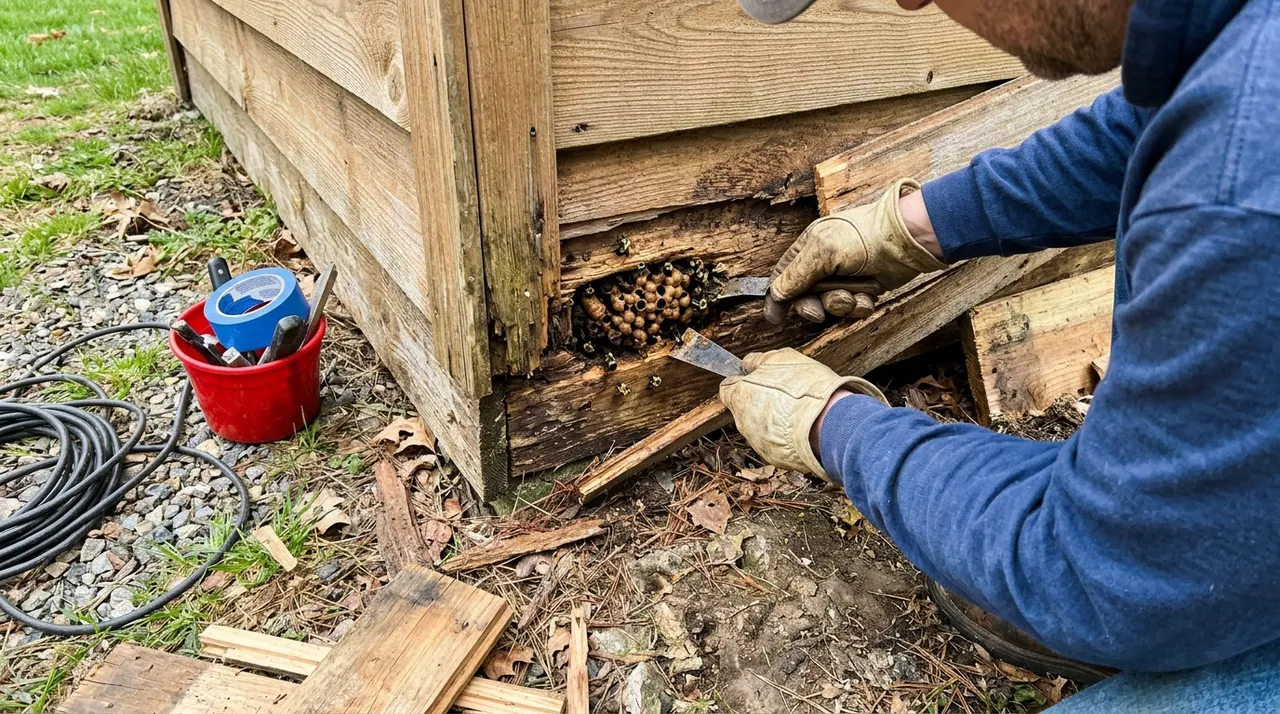
The female carpenter bee operates like a living drill bit. She chews a perfectly round, half-inch hole straight up into the bottom of a piece of wood. Once she reaches a depth of about an inch, she makes a sharp 90-degree turn and tunnels parallel to the wood grain. These galleries can stretch for several feet. Inside, she packs small balls of pollen and nectar (called bee bread), lays an egg on each one, and seals the chamber with a wall of chewed wood pulp. The most obvious sign of an active carpenter bee nest is a pile of coarse sawdust, known as frass, accumulating on the ground directly below the hole.
Aggression and Stinging Risks
Most homeowners misjudge which of these two insects is actually dangerous.
The male carpenter bee is responsible for 90 percent of the panic in Gilbertsville backyards. He is highly territorial and will aggressively dive-bomb your head, your pets, or even the mail carrier if you walk near the nest. However, it is entirely a bluff. Male carpenter bees do not possess a stinger. They are physically incapable of hurting you. The female carpenter bee does have a stinger, but she is incredibly docile. She spends almost all her time inside the wood or foraging, and she will typically only sting if you try to catch her in your bare hand or accidentally squeeze her.
Bumblebees, on the other hand, demand far more caution. While they are peaceful when foraging on flowers, they are fiercely protective of their colony. Because their nests are in the ground, they are highly sensitive to vibration. If you accidentally step on a nest opening, run a lawnmower over the area, or hit their territory with a weed whacker, the workers will pour out and attack. Unlike honeybees, a bumblebee does not lose its stinger after an attack, meaning a single bee can sting you multiple times in rapid succession.
The Ripple Effect of Property Damage
Bumblebees generally cause zero property damage. They move into existing holes in the dirt, live out their summer, and the colony dies off in the winter. Carpenter bees are a different story entirely.
A single carpenter bee tunnel might only weaken a small strip of wood, but the real threat comes from their generational habits. Female carpenter bees instinctively return to the exact same galleries where they were born to lay their own eggs. Over a few years, a single hole in your fascia board can turn into a massive network of tunnels. This structural hollowing invites water intrusion, leading to severe wood rot.
Worse, the larvae developing inside the wood act as a dinner bell for woodpeckers. A woodpecker can hear the fat larvae scratching inside the tunnel. To get to them, the bird will tear the face of your siding or deck apart, turning a neat half-inch hole into a massive, jagged trench of ruined wood overnight. When repairing severe structural damage from wood-destroying organisms, the Pennsylvania Uniform Construction Code sets standards for structural repairs, though requirements vary by municipality, so confirm with your local building department.
Why DIY Removal Usually Fails
When a homeowner spots a carpenter bee hole, the first instinct is usually to grab a tube of silicone caulk and plug it. This is the worst thing you can do. If you trap a female bee inside her tunnel, she will simply chew her way out, often bypassing the caulk and drilling deeper into your home's framing to find a new exit. Spraying retail wasp killer into the hole is equally ineffective; the tunnels are deep and winding, meaning the liquid rarely reaches the larvae.
Similarly, trying to drown out a ground-nesting bumblebee colony with a garden hose usually just provokes the hive into a defensive frenzy, putting anyone in the yard at risk of multiple stings.
Professional Extraction and Structural Repair
Telling the difference between these insects is just the first step; properly resolving the issue requires targeted expertise. At Honeybee Rescue Company, we deal with stinging insect problems across the region, including the situations that retail sprays cannot handle.
Because of our strict no-kill policy for beneficial pollinators, we focus heavily on live bee relocation services. When we extract a colony, we move them to our own private apiaries where they can rehabilitate and thrive. When you need help handling a bumblebee removal in Gilbertsville, we apply this same level of care to ensure the insects are managed safely and responsibly.
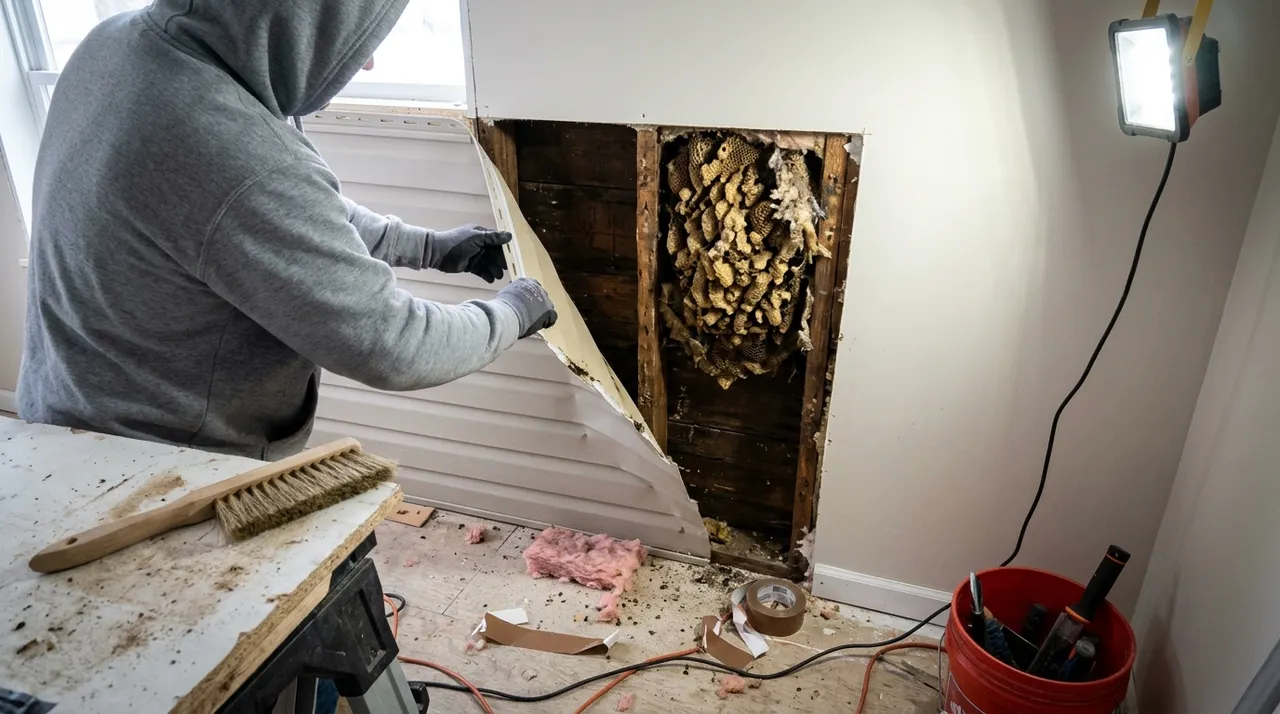
For structural pest control involving wood-boring insects, wasps, or hornets living inside your walls, we don't just eliminate the threat. We perform full-service structural cut-outs and damage repair. Once the pests are gone, we rebuild the wood properly so your home's integrity is completely restored. Every project is different, and the only way to know what your specific property needs is to have an expert take a look. Fill out the contact form on our website to schedule an inspection and get a quote for your home.
Common Questions
Frequently Asked Questions
Ready To Start?
Get Your Quote Today
Get a quote from Honeybee Rescue Company — serving Gilbertsville and surrounding areas.